

Covered Call Checklist: 6 Things to Review Before Trading
Six-step covered call checklist: pick stable stocks, assess IV and liquidity, choose strike and 30–45 day expiry, calculate risk/reward, and size positions.
A covered call strategy lets you generate income by selling call options on stocks you own, but it limits your upside potential. To execute this strategy effectively with an options strategy planner, you need to evaluate six critical factors:
- Stock Selection: Focus on stable, long-term investments with strong fundamentals, high liquidity, and minimal price volatility.
- Volatility Analysis: Check implied volatility (IV) to ensure premiums are worthwhile. Compare IV to historical volatility and IV Rank to identify favorable opportunities.
- Strike Price: Choose a strike price based on your income goals and risk tolerance. Use Delta to estimate the likelihood of assignment.
- Expiration Date: Target 30–45 day expirations for optimal time decay and premium income while avoiding earnings or dividend dates that could increase assignment risk.
- Risk and Reward: Calculate maximum profit, breakeven point, and effective selling price to ensure the trade aligns with your financial goals.
- Portfolio Alignment: Limit position sizes to 1–3% of your portfolio and monitor portfolio Greeks (Delta, Theta, Vega) to maintain balance and reduce risk.
This checklist helps you avoid common mistakes and ensures your trades align with your financial strategy. By following these steps, you can make informed decisions and manage risk effectively.
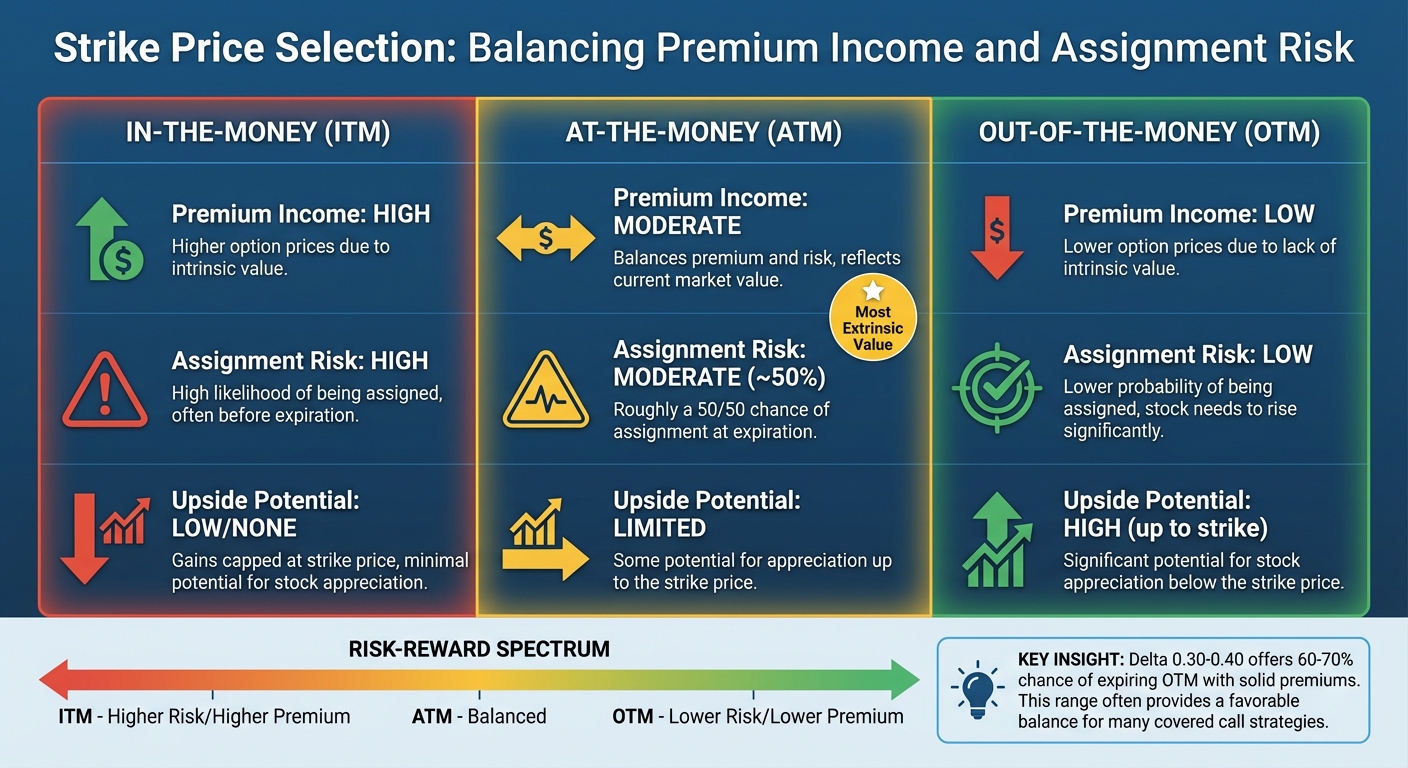
Covered Call Strike Price Comparison: Premium Income vs Assignment Risk
1. Choose the Right Stock
Not every stock is a good fit for covered calls. The key is to choose stable, long-term investments that help protect your premium income. A solid stock selection strategy involves finding companies you’re comfortable holding for the long haul, with enough stability to avoid sharp price drops that could wipe out your premium. From there, evaluate factors like market conditions, liquidity, and technical indicators.
Check the Market Outlook
Covered calls work best in a flat or slightly rising market. If the stock surges significantly, your gains will be capped at the strike price, which could mean missing out on higher profits. If you're expecting a sharp rise, you might want to hold off on selling a call. Instead, focus on high-quality, blue-chip stocks with strong fundamentals and a price-to-earnings (P/E) ratio of 60 or less.
"The most important aspect of any investment strategy might be stock selection. Not all stocks will make good covered call candidates." - Jesse Anderson, OptionDash
Review Liquidity
Liquidity is critical for both the stock and its call options. Ideally, the stock should trade at least 1,000,000 shares daily, and the options series should have an open interest of at least 2,500 contracts. Additionally, check the bid-ask spread on the option - it should be no more than 10% of the ask price. For instance, if a call option has a bid of $0.90 and an ask of $0.95, the $0.05 spread (about 6% of the ask price) indicates a healthy level of liquidity.
Look at Technical and Fundamental Indicators
Start with fundamental analysis to ensure the stock is profitable and financially sound, then use technical analysis to time your entry. On a daily chart, confirm the stock is trading above its 50-day moving average and showing either an uptrend or a stable trading range. Steer clear of stocks hitting resistance levels or trending downward, as these could signal trouble. Identify key support and resistance levels, and check if recent price movements align with higher-than-normal trading volume. Keep an eye on corporate events that could lead to sudden price swings.
"The constants for success in investing are and always will be patience and discipline. But the good news is that, when your writing is confined to conservative stocks, and you carefully apply sound fundamental and technical analysis, it is simply difficult to go wrong." - Financhill
sbb-itb-a9ac3c2
2. Check Volatility Levels
Volatility plays a huge role in determining your premium income. Implied volatility (IV) measures how much the market expects a stock's price to move and directly impacts option premiums. When IV is high, premiums increase, giving you the chance to collect more income. On the flip side, low IV means smaller premiums, making strategies like covered calls less appealing. It’s important to note that IV doesn’t indicate whether prices will go up or down - it only reflects the potential size of the movement.
Check Implied Volatility (IV)
Before selling a covered call, always examine the option’s IV to ensure you’re capturing enough premium. For instance, if a stock usually trades with an IV of 25% but suddenly spikes to 55%, there’s likely a significant event driving this change.
Take Walgreens Boots Alliance (WBA) as an example. Its 30-day historical volatility was 23.5%, but a trader noticed a call option priced at $3.23 (with the stock at $83.11 and a strike price of $80), which implied a volatility of 54.1%. The 9% difference between historical volatility and implied volatility suggested that the market was preparing for a major price shift.
IV can also help you estimate a stock’s expected price range. For example, if a stock is priced at $100 with a 20% IV, there’s about a 68% chance it will stay within a $5.77 range over the next month (calculated as 20%/√12). This insight helps you decide if your strike price is safely positioned outside the expected range.
Comparing the current IV to the stock’s historical volatility gives you an even clearer picture.
Compare Historical Volatility and IV Rank
To fully understand IV, compare it to the stock’s historical data. A raw IV number means little without context. For example, a 40% IV might seem high for a utility stock but be completely normal for a tech stock. That’s where IV Rank comes in - it shows how the current IV compares to the stock’s 52-week high and low, on a scale of 0 to 100. A rank above 50 means options are relatively expensive, making it a good time to sell covered calls. If the rank is below 30, premiums are likely too low, and it might be better to wait for a more favorable opportunity.
"By selling when prices (premiums) are high and buying when they're low, we create an edge." – TradeSmith Editorial Staff
Another helpful metric is the comparison between IV and historical volatility (HV), which measures the stock’s actual past price movements. When IV is much higher than HV, options are often overpriced, providing a prime opportunity to sell premiums. For instance, in February 2022, Cisco Systems (CSCO) demonstrated this pattern. Its February 18 option chain had an IV of 40.36% ahead of its February 16 earnings, while a later chain (June 17) showed an IV of just 31.37%. That 9% difference hinted at a potential "volatility crush" after the earnings release, allowing traders to capture inflated premiums.
Keep an eye out for events like earnings announcements, which often lead to an IV crush. This drop in IV can quickly reduce the value of your short option, enabling you to lock in profits early or let the premium work in your favor.
3. Pick the Right Strike Price
Once you've assessed volatility levels, the next step is to zero in on a strike price that aligns with your income goals and comfort with risk. This choice directly impacts the premium you earn, the likelihood of retaining your shares, and the chances of assignment.
Use Probability Analysis
Delta can be a useful tool for gauging the probability of an option expiring in-the-money. For example, a call option with a Delta of 0.30 suggests a 30% chance of finishing in-the-money, leaving a 70% chance it will expire worthless. In this scenario, you’d keep both the premium and your shares. Options with Deltas between 0.30 and 0.40 typically offer a 60–70% chance of expiring out-of-the-money while still providing solid premiums.
"The strike price is the key decision that controls the risk/reward for your position." – PowerOptions
If your goal is to hold onto your shares, you might aim for strikes with only a 15–20% probability of assignment. On the other hand, at-the-money (ATM) strikes carry roughly a 50% chance of assignment but offer higher premiums in exchange for increased risk. Keep in mind that only about 10% of options contracts are exercised, while approximately 30% expire worthless.
This analysis helps you balance premium income with the risk of assignment.
Weigh Premium Income Against Assignment Risk
The relationship between premium income and assignment risk is straightforward: higher premiums often come with a higher chance of assignment. Here's how different strike types compare:
| Strike Type | Premium Income | Assignment Risk | Upside Potential |
|---|---|---|---|
| In-the-Money (ITM) | High | High | Low/None |
| At-the-Money (ATM) | Moderate | Moderate (~50%) | Limited |
| Out-of-the-Money (OTM) | Low | Low | High (up to strike) |
ITM strikes provide substantial premiums and some downside protection but come with a higher likelihood of assignment. OTM strikes, while offering lower premiums, preserve more upside potential. ATM strikes sit in the middle, offering the most intrinsic and extrinsic value and a balanced risk-reward profile.
To maximize your strategy, consider setting strikes near your target exit price. This allows you to collect premiums while working toward your selling goals. A word of caution: avoid writing calls before earnings announcements to minimize exposure to increased volatility and the risk of assignment.
4. Select the Expiration Date
Once you've chosen a strike price, the next step is to pick an expiration date that strikes a balance between maximizing premium collection and minimizing the time spent managing your trades. It's also important to consider any market events that could disrupt your strategy.
Target 30-45 Day Expirations
The sweet spot for covered calls tends to be the 30-45 day range. Why? Because time decay - the gradual loss of an option's value - accelerates significantly as expiration approaches. For example, while a one-year option might yield a 10.73% annualized return, a shorter 22-day option can deliver a much higher annualized return of 45.84%, even though the total premium is smaller. This faster decay allows for more frequent opportunities to collect premiums.
"The rate of time decay actually accelerates as the expiration date nears." – Snider Advisors
Monthly options, in particular, offer several advantages. They tend to have better liquidity, tighter bid-ask spreads, and less slippage compared to weekly options. Plus, they require less monitoring while still providing enough premium to make the strategy effective. Standard monthly options typically expire on the third Friday of each month.
Watch Out for Earnings and Dividend Dates
Before finalizing your expiration date, check for any upcoming earnings reports or ex-dividend dates. Earnings announcements can cause a spike in implied volatility, leading to sharp price movements that might push your stock price above the strike, increasing the risk of early assignment.
Dividend dates, on the other hand, carry a different type of assignment risk. If your call option is in-the-money as the ex-dividend date approaches, the option buyer may choose to exercise early to capture the dividend. This is especially likely if the dividend amount exceeds the remaining time value of the option. To avoid losing your shares and the dividend, consider these strategies:
- Select an expiration date that falls after the ex-dividend date.
- Avoid selling deep in-the-money calls during this period.
"The ex-dividend date is when the stock begins trading without the upcoming dividend. Call holders may exercise before this date to capture the dividend if the dividend exceeds remaining time value." – ImpliedOptions
5. Calculate Risk and Reward
Before stepping into a covered call trade, it’s essential to crunch the numbers to understand your potential gains and losses. This way, you can avoid any unexpected outcomes.
Crunching Key Numbers
Start by figuring out your maximum profit - this is the most you can earn if the stock price hits or surpasses the strike price when the option expires. The formula is simple: (Strike Price - Stock Purchase Price) + Premium Received. For example, if you purchased a stock at $350, sold a $385 call for $5.80, and the stock climbs to $385 or more, your maximum profit would be:
($385 - $350) + $5.80 = $40.80 per share, or $4,080 per contract.
Next, calculate your breakeven point, the price at which you neither make nor lose money. This is determined by subtracting the premium received from the stock purchase price. Using the same example, the breakeven point is:
$350 - $5.80 = $344.20 per share. This means you have a $5.80 cushion per share before the trade turns unprofitable.
"The seller of a covered call gets paid a premium in exchange for giving up a portion of future potential upside." – Investopedia
Finally, determine the effective selling price, which is the total amount you’d receive if the stock gets called away. The formula here is: (Strike Price + Premium Received). Using our example, this would be:
$385 + $5.80 = $390.80 per share. It’s crucial to ensure you’re comfortable selling your shares at this price before entering the trade.
Once you’ve calculated these numbers, assess the likelihood of assignment to complete your risk-reward analysis.
Understanding Assignment Risk
Assignment happens when the option buyer decides to exercise their right to purchase your shares at the strike price. This typically occurs when the trade goes as planned, especially if your call is in-the-money at expiration.
"The covered call is a neutral to bullish strategy, and being assigned typically means the stock has stayed relatively neutral or increased somewhat in value." – Fidelity
Although early assignment is rare, it can happen - most often when there’s little to no time value left in the option or just before an ex-dividend date. If the dividend exceeds the remaining time value of the call, the buyer might exercise early to capture that dividend. To handle this, calculate the "if-called return" to ensure the potential profit aligns with your goals. If holding onto your shares is a priority, you can "roll" the position by buying back the call and selling another with a later expiration or higher strike price.
6. Match Your Portfolio Goals
Just as it's crucial to balance risk and reward, it's equally important to align your trades with your overall portfolio objectives. Every covered call trade should fit seamlessly into your broader strategy and reflect your tolerance for risk. Let’s break down two key aspects: managing position size and tracking portfolio Greeks, to ensure your trades are working toward your financial goals.
Manage Position Size
Getting position sizing right can make or break your options trading success. A good rule of thumb is to allocate between 1% and 3% of your total portfolio value to any single investment. This helps shield your portfolio from significant losses caused by unexpected events. For instance, if your portfolio is worth $100,000, you should limit any covered call position to $1,000–$3,000 in notional value.
"Position sizing is ultimately one of the things that will lead to most people failing in options trading." – Kirk Du Plessis, Founder, Option Alpha
In periods of low implied volatility (IV), consider tightening your allocations even further to the 1–2% range. During these times, maintaining a higher cash balance can act as a buffer against sudden volatility spikes. Additionally, keep your total exposure to options income strategies between 5–15% of your portfolio to avoid over-reliance on options. Be mindful of sector exposure too - limit your total investments in any single sector or correlated group to 8–10% of your portfolio. Diversification is key to avoiding concentrated risks.
Track Portfolio Greeks
If you're managing multiple covered calls, keeping an eye on your portfolio Greeks is essential. These metrics help you understand how your trades interact with one another. For example:
- Delta measures your portfolio's directional risk. If your portfolio is already leaning bearish, adding another bearish trade - even if it seems promising - could create an imbalance.
- Theta tracks the daily income you're generating from time decay across all positions.
- Vega shows how sensitive your portfolio is to changes in market volatility.
Tools like ThetaEdge make it easier to manage these metrics by aggregating the data from all your covered calls. With a quick glance, you can see whether your portfolio's exposure is neutral, bullish, or bearish compared to benchmarks like the S&P 500. By regularly monitoring these metrics, you can ensure your covered call strategy stays aligned with your objectives, whether you're focused on steady income, reducing risk, or maintaining a balanced approach.
Conclusion
Trading covered calls without a structured method can lead to costly mistakes. The six checklist items we've discussed provide a clear framework to eliminate unsuitable trades and focus your resources on opportunities that align with your portfolio's objectives.
This checklist serves as the backbone of your strategy. As Kirk Du Plessis, Founder of Option Alpha, explains:
"The whole goal here is to give you an opportunity to analyze trade quickly and move on from trades that don't fit or don't meet your criteria for entering a trade."
Each step - whether it's selecting the right stock, evaluating volatility, choosing strike prices, timing expirations, calculating risk/reward, or ensuring trades match your portfolio goals - helps steer you away from common errors, such as selling calls on stocks with imminent earnings or neglecting key metrics like assessing liquidity and IV Rank.
If managing these details feels overwhelming, ThetaEdge offers a solution. The platform automates these processes, ensuring your strategy hits every checklist item effortlessly. With institutional-grade analysis, AI-powered insights through Thetix, and the ability to consolidate Portfolio Greeks across 80+ brokerages, ThetaEdge simplifies the complexity. You'll receive daily action plans highlighting top opportunities and expiring positions, allowing you to make informed, decisive moves.
Take control of your covered call strategy. Join the ThetaEdge Beta program today to access professional tools at founder pricing.
FAQs
What role does implied volatility play in determining covered call premiums?
Implied volatility (IV) is a key factor in shaping the premiums you can earn with a covered call strategy. When IV is elevated, option prices generally rise, allowing you to collect higher premiums. On the flip side, when IV drops, option prices fall, leading to smaller premiums.
Grasping how IV works can help you better time your trades. Higher IV often signals greater market uncertainty, which can create opportunities to boost income from covered calls. That said, it's equally important to weigh the risks that come with heightened market volatility before committing to a trade.
What should I consider when selecting a strike price for a covered call?
When choosing a strike price for a covered call, it's crucial to understand how the strike price relates to the stock's current market value - this is often called moneyness. Strike prices generally fall into one of three categories:
- In the Money (ITM): The strike price is lower than the stock's current market price. This option generates higher premium income but limits your potential for further gains if the stock price rises.
- At the Money (ATM): The strike price is close to the stock's current price. This provides a balance between decent premium income and moderate upside potential.
- Out of the Money (OTM): The strike price is higher than the stock's current price. While the premium income here is lower, it allows more room for the stock's price to increase.
The right choice depends on your investment goals - whether you're aiming to maximize income, lock in profits, or leave room for growth. Keep in mind the stock's volatility, as this can influence the chances of the option being exercised. Ultimately, your decision should align with your broader portfolio strategy and risk comfort level.
Why should I align covered call trades with my portfolio goals?
Aligning covered call trades with your portfolio goals is crucial to make sure your strategy supports your financial objectives, risk tolerance, and income needs. For example, if you're aiming to generate consistent income or cushion against market dips, covered calls can offer extra cash flow while providing some downside protection. However, if your priority is long-term growth, selling calls could cap your potential gains, which might not align with that strategy.
By customizing covered call trades to suit your portfolio, you can create a more balanced and purposeful investment plan. This ensures that each trade works in harmony with your overall asset allocation and financial objectives, keeping your strategy focused and consistent over time.