

How to Use Time-Based Exits in Covered Calls
Use time-based exits for covered calls—capture 50–75% of premium or exit ~21 days before expiration to manage theta and assignment risk.
When selling covered calls, timing your exit can make a big difference. A time-based exit strategy focuses on closing or rolling your position before expiration - often around 21 days out. This approach helps you benefit from the fastest period of time decay (theta) while avoiding risks like share assignment or sudden price swings. Here's the key idea: exit after capturing 50%–75% of the premium or when 21 days remain, whichever happens first. This method balances income generation with risk management.
Key Points:
- Time Decay (Theta): Options lose value faster as expiration approaches, especially in the last 30–45 days.
- Exit Timing: Closing 21 days before expiration avoids gamma risk and increases flexibility.
- Profit Targets: Many traders aim for 50%–75% of the premium to lock in gains.
- Tools: Platforms like ThetaEdge help track metrics and identify opportunities.
How Time Decay Affects Covered Calls
Time decay, represented by theta, measures how much value an option loses each day. For covered call sellers, this decay works in your favor: while option buyers watch their premiums shrink, you can benefit even if the stock price stays flat.
Theta only impacts the extrinsic (time) value of an option - not its intrinsic value. For instance, an option with a theta of -0.05 loses $5 per contract daily. This decay isn't constant; it speeds up significantly during the last 30 to 45 days before expiration, with the sharpest decline happening as the expiration date approaches.
"Understanding Theta is the key difference between letting this force work against you and using it to your advantage. For anyone buying options, time decay is a daily headwind. But for option sellers, it's a reliable tailwind pushing your trade forward."
- John Clarke, Strike Price
What Theta Means for Options Sellers
When you sell a covered call, you hold a positive theta, meaning time is on your side. Unlike the option buyer, who needs significant stock movement to profit, you can gain even if the stock price remains unchanged.
At-the-money (ATM) options carry the highest extrinsic value and, therefore, the highest theta. In contrast, deep in-the-money or far out-of-the-money options have lower extrinsic value and reduced theta.
The rate of decay often doubles between the 30-day and 15-day marks. This acceleration highlights why understanding the decay curve is essential for planning when to exit your position. Knowing how theta behaves can guide your strategy as time decay speeds up.
Using Time Decay to Plan Your Exits
A window of 30 to 60 days before expiration is often considered ideal. During this period, time decay works quickly enough to generate meaningful income while still leaving room to adjust your trade if the stock moves. Many experienced traders aim to exit short positions after capturing 50%–75% of the maximum profit. This strategy allows them to lock in gains, reduce exposure to the risks of the final days, and free up capital for new opportunities.
"Selling options isn't about predicting the next move. It's about structuring trades that profit if nothing happens, and letting time do the rest."
- Andy Crowder, The Option Premium
While the last week before expiration may deliver the fastest decay rates, it also comes with higher risks of assignment and unexpected price swings. Understanding these nuances of time decay can help you establish clear time-based exit strategies for covered calls. Recognizing these patterns ensures you make informed decisions about when to close positions rather than chasing the last bit of premium.
sbb-itb-a9ac3c2
How to Implement Time-Based Exits
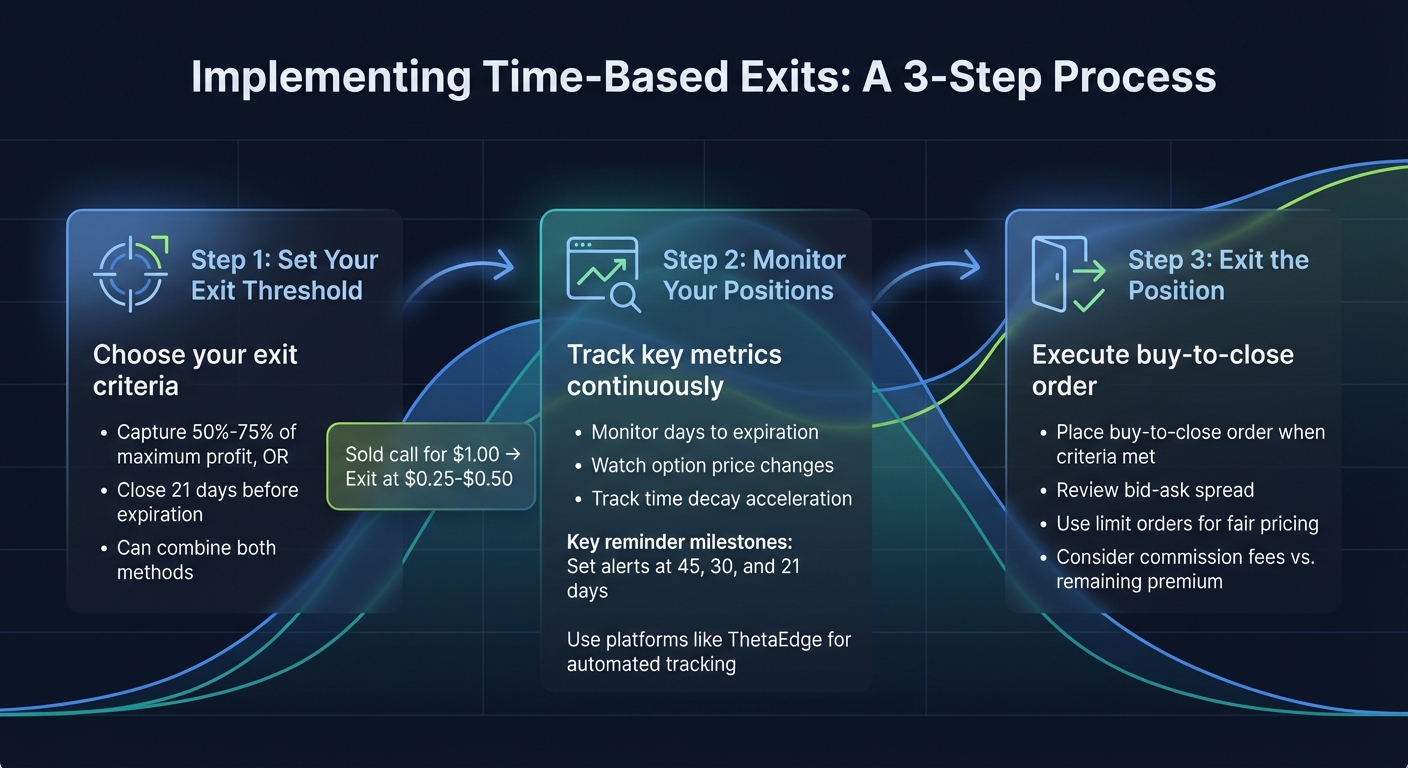
Time-Based Exit Strategy for Covered Calls: 3-Step Implementation Guide
Using time-based exits can help you capture premium while keeping risks in check. Here's how you can structure and execute this type of exit strategy effectively.
Step 1: Set Your Exit Threshold
Decide on a clear point to exit your position. A common approach among experienced traders is to aim for capturing 50% to 75% of the maximum profit - the premium you initially collected - or to close the position 21 days before expiration to balance returns with the risk of assignment.
For instance, if you sold a covered call for $1.00 per share (equivalent to $100 per contract), you might plan to buy it back when its price drops to $0.25 to $0.50. Alternatively, you could choose to close the position when there are 21 days left until expiration. Some traders combine both methods, exiting as soon as either the profit target is hit or the 21-day mark arrives.
Step 2: Monitor Your Positions
Keep an eye on critical metrics like days to expiration and the option's price to know when to act. As time passes - especially in the final weeks - time decay accelerates, which should cause the option's value to drop more significantly.
Set reminders for key points, such as 45, 30, and 21 days to expiration, to ensure you stay on track. Automated tools can also be a big help here. Platforms like ThetaEdge connect to over 80 brokerages, offering real-time tracking of Greeks and performance metrics.
"Options intelligence is continuous, not a one-time lookup." - ThetaEdge
Once your monitoring shows that your exit threshold has been reached, it's time to move forward and close the position.
Step 3: Exit the Position
When your exit criteria are met, place a buy-to-close order for the call option. This action removes your obligation and releases your shares.
Before executing the order, review the bid-ask spread. If necessary, use a limit order slightly above the bid price to ensure a fair transaction. Be mindful of commission fees, as they can eat into your profits if the remaining premium is small. In some cases, it might make more sense to let the option expire instead of closing it manually.
What to Do After Closing a Position
Once you've wrapped up a covered call trade, it's time to evaluate how it went and start planning your next move.
Calculate Your Returns
Start by crunching the numbers to see how the trade performed. Your total return includes the net premium you kept plus any change in the stock's value. Be sure to subtract commissions and fees for both the stock and option legs of the trade.
Here’s an example from Investopedia: An investor bought shares of XYZ at $50 and sold a $55 strike call for a $4 premium. When the stock climbed to $60 and the shares were assigned, the profit was $5 (capital gain to the strike) + $4 (premium) = $9 per share. That’s an 18% return in six months. On the flip side, if the stock had fallen to $40 and the option expired worthless, the loss would have been $10 (stock decline) - $4 (premium kept) = $6 per share, or a -12% return.
Tools like ThetaEdge’s income tracking dashboard simplify this process. It calculates returns, tracks historical performance, and even allows you to filter by year. This data can help you pinpoint successful trades and adjust your strategy for future opportunities.
Find Your Next Covered Call
With your returns calculated, it’s time to look for your next covered call opportunity. The shares you still hold can be used to generate more income. The ideal window to initiate a new covered call is 45–60 days before expiration, a period when time decay accelerates while keeping gamma risk manageable. Focus on stocks that have risen 5%–15% in the last 2–4 weeks or those nearing resistance levels.
ThetaEdge can streamline this process by scanning your portfolio for new opportunities. It provides detailed risk metrics, including strike price, expiration, premium, Delta, and breakeven points - all tailored to your holdings. The platform supports over 80 brokerages and has analyzed more than $26 million in assets, with the average member portfolio sitting at $300,000.
"More people want to make their own destiny, and ThetaEdge empowers them to do it with the same tools the elite have always used." - Maxim Khailo, Founder & CEO, ThetaEdge
Wrapping Up
Using time-based exits helps you take advantage of optimal theta decay while keeping gamma risk in check. Exiting trades roughly 21 days before expiration allows you to lock in about 50% of the extrinsic value and redirect your capital toward new opportunities. By sticking to clear, repeatable rules - like closing at 50% profit or exiting at the 21-day mark - you can build a consistent approach to compounding returns.
Platforms such as ThetaEdge simplify this process by monitoring your positions, calculating your returns, and identifying fresh opportunities based on your portfolio. With connections to over 80 brokerages, it provides advanced risk metrics for each trade while leaving execution in your hands. As Maxim Khailo, the platform’s founder, advises: "Use theta to generate income with covered calls: target 30–45 days to expiration, and close or roll around 21 days to limit assignment risk".
FAQs
Should I close at 50% profit or wait until 21 DTE?
The decision boils down to your personal approach and comfort with risk. Closing a position at a 50% profit is ideal for locking in quick wins, while holding until about 21 days to expiration (DTE) strikes a balance between collecting premium and managing risk. Selling covered calls with 10–45 days to expiration often aligns with the sweet spot for maximizing theta decay. To fine-tune your strategy, you might explore rolling positions or closely monitoring the Greeks, tailoring your moves to match your income goals and risk tolerance.
When should I roll a covered call instead of closing it?
When managing a covered call, rolling can be a smart move if you want to keep the position active, steer clear of assignment, or continue benefiting from the stock's performance. This approach is particularly helpful when the option is close to expiration but still holds some value, or if shifting the strike price or expiration date better matches your expectations for the stock's future.
On the other hand, closing the position might make more sense if the stock has already reached your profit goal or if changing market conditions make holding the position less appealing.
How do taxes change when I close early or get assigned?
When you close a covered call early or get assigned, the tax implications differ. Closing early usually leads to short-term capital gains, which are reported in the year the transaction occurs. If you're assigned, the option premium is factored into the stock's sale price. The tax treatment then hinges on your holding period for the stock - whether it qualifies as short-term or long-term, depending on how long you owned the shares before the assignment.