

Covered Call Risk Management: 8 Essential Tips
Practical risk controls for covered call sellers: choose steady stocks, use OTM strikes and short expirations, roll positions, diversify and track Greeks.
Covered calls can generate steady income for stockholders, but they come with risks. This article highlights 8 key strategies to manage those risks effectively:
- Pick Stocks with Steady Volatility: Choose stocks with predictable price movements to reduce assignment risk and stabilize income.
- Use Out-of-the-Money Strike Prices: Selling calls above the current stock price balances income and growth while lowering assignment chances.
- Trade Shorter Expiration Periods: Short-term options allow quicker adjustments and higher annualized returns.
- Watch and Control Assignment Risk: Monitor assignment risks, especially near ex-dividend dates, to avoid unwanted share sales.
- Use Roll Strategies: Adjust positions by rolling options to new strikes or expirations to manage risks and boost income.
- Spread Risk Across Multiple Positions: Diversify across stocks and stagger expirations to reduce concentrated risks.
- Track Portfolio Greeks: Use Greeks like Delta and Theta to understand and manage portfolio exposure.
- Measure Income and Performance Data: Regularly calculate breakeven points, static returns, and if-called returns to ensure the strategy aligns with your goals.
These strategies help maintain control over your portfolio, reduce potential losses, and maximize income opportunities from covered call trades.
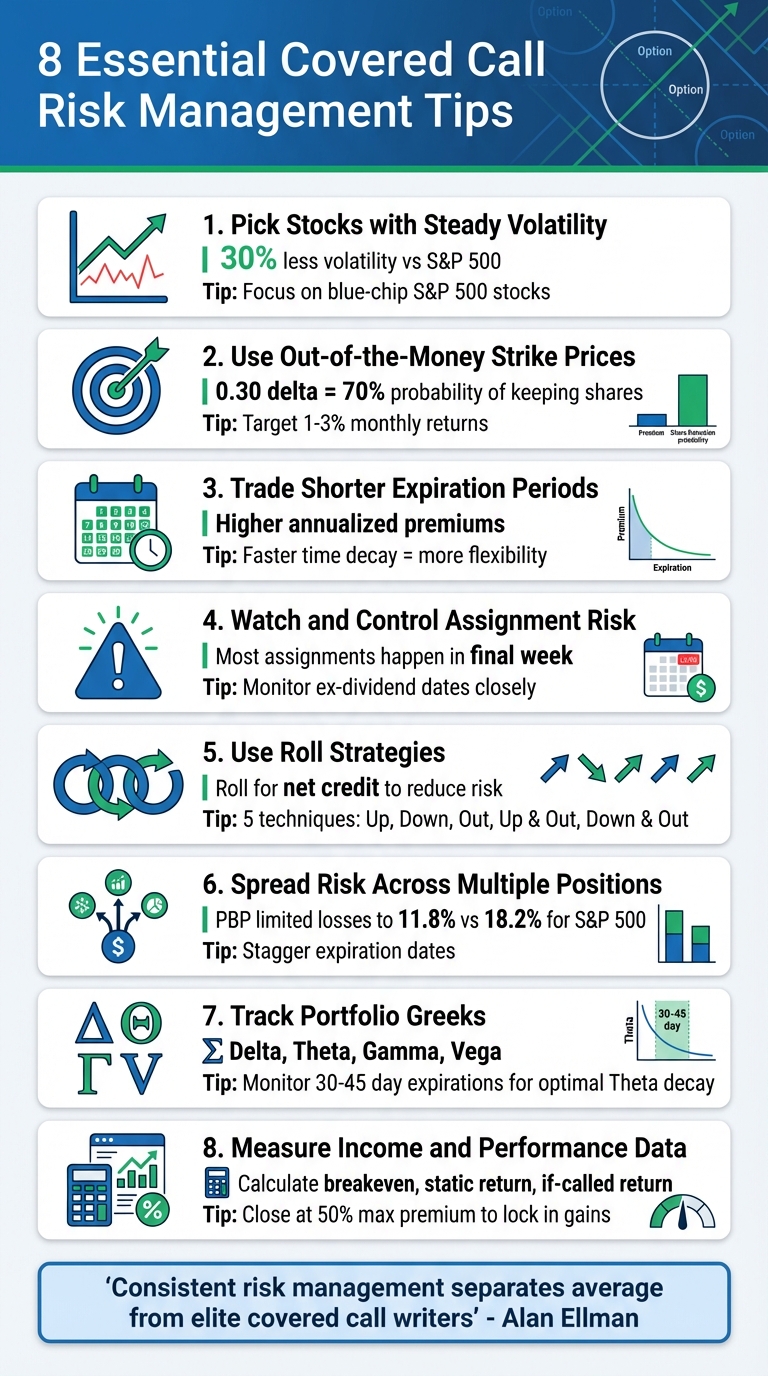
8 Essential Covered Call Risk Management Strategies
1. Pick Stocks with Steady Volatility
Choosing stocks with steady volatility can help reduce assignment risk and improve the performance of covered call strategies. This approach works well in markets with a neutral to slightly bullish outlook. The consistent behavior of these stocks not only stabilizes income but also minimizes surprises like unexpected assignments.
Risk Reduction Potential
Stocks with predictable price movements lower the likelihood of assignments and help secure your breakeven point. Blue-chip companies from the S&P 500 are often a solid choice for this - they're well-established, have consistent earnings, and avoid sharp price swings. For example, the Cboe S&P 500 BuyWrite Index (BXM), which tracks covered call strategies from 1986 to 2023, demonstrated nearly 30% less volatility compared to the S&P 500. Its maximum drawdown was 35.8%, notably less severe than the S&P 500's 51% decline.
Impact on Portfolio Income
Beyond reducing risk, steady stocks also provide a reliable source of income. While they tend to yield lower premiums, these premiums are more consistent. Since roughly 75% of call options expire worthless, investors often retain both the premium and their shares. To estimate daily price movements, you can apply the "Rule of 16": divide a stock's implied volatility (IV) by 16. For instance, a stock with a 32% IV is expected to move about 2% per day. Look for options with a delta between 0.30 and 0.40, as this gives a 60%–70% likelihood that the option will expire out-of-the-money.
Ease of Implementation
Finding steady stocks is relatively simple. Focus on mature, dividend-paying companies with moderate 52-week IV percentiles and liquid options (where the bid-ask spread is no more than 10% of the ask price).
For example, in November 2022, an investor holding Microsoft Corp. (MSFT) at $242 sold a call option expiring on January 20, 2023, with a $250 strike price, earning a $10 premium. By expiration, MSFT closed at $240 - just $2 below the purchase price. Thanks to the stock's steady volatility, the investor kept their shares, the $10 premium, and also earned a $0.68 dividend. This resulted in a 3.6% return in under three months, even with a slight dip in the stock price.
sbb-itb-a9ac3c2
2. Use Out-of-the-Money Strike Prices
Focusing on out-of-the-money (OTM) strike prices can help you better manage risk while still allowing for portfolio growth.
Risk Reduction Potential
Selling OTM calls - those with strike prices above the current stock price - creates a buffer against assignment. Since these options require the stock to rise above the strike price for assignment, they offer a margin of safety. For instance, deep OTM calls with a delta between 0.15 and 0.25 carry only a 5% to 10% assignment risk, while standard OTM calls with a delta range of 0.25 to 0.40 have a moderate 20% to 30% risk. This setup allows your stock to appreciate up to the strike price, letting you benefit from both the premium and potential capital gains - advantages often lost with at-the-money (ATM) or in-the-money (ITM) strikes.
For example, during a bear market, a buy-write strategy applied to the S&P 500 limited losses to 11.8%, compared to the index's 18.2% decline. This demonstrates how premiums can cushion losses. Pairing this strategy with steady volatility selection further minimizes assignment risk.
Impact on Portfolio Income
While OTM options generate lower premiums, they strike a balance between income and growth. Traders often aim for monthly returns of 1% to 3% with this approach. A 0.30 delta strike is frequently seen as the "sweet spot", offering a good mix of income and security. With a 70% probability that the option will expire worthless, you keep both the premium and your shares.
| Strike Type | Delta Range | Premium Level | Assignment Risk | Primary Objective |
|---|---|---|---|---|
| Deep OTM | 0.15–0.25 | Low | Very Low (5–10%) | Conservative; keeping shares |
| Standard OTM | 0.25–0.40 | Medium | Moderate (20–30%) | Balanced income and growth |
| At-the-Money | 0.45–0.55 | High | High (~50%) | Maximum income; okay with exit |
| In-the-Money | 0.60–0.80 | Very High | Very High (70–90%) | Planning to exit position |
Flexibility for Adjustments
OTM options consist entirely of time value, making them easier to adjust if the stock moves close to the strike price. If this happens, you can roll the option to a higher strike or later expiration, often for a net credit. This allows you to capture additional upside while delaying assignment.
"The benefit of rolling out is that an investor receives more option premium, which can be kept as income if the new call expires." - Fidelity
To optimize time decay, aim for expiration dates 30 to 45 days out. Before entering a trade, calculate your "if-called" return - this includes the premium plus any stock appreciation up to the strike price. This ensures you're comfortable with the exit price if assignment occurs. Lastly, avoid selling OTM calls before earnings or major announcements, as sudden price spikes could push the stock well past your strike price, limiting your potential gains.
3. Trade Shorter Expiration Periods
Risk Reduction Potential
Shorter expiration periods give you the chance to adjust strike prices and align your positions with current market trends. This approach minimizes the risk of being stuck with a less-than-ideal strike price during unexpected market rallies. Plus, collecting premiums from these shorter-term contracts builds a financial buffer, helping to offset potential losses during market downturns. The shorter commitment also means you're less likely to miss out on significant share price gains if the market takes off. This agility can lead to better annualized returns over time.
Impact on Portfolio Income
Short-term options often generate higher annualized premiums, thanks to faster time decay.
"Short-term options tend to have a higher price relative to their length than do longer-term options." - AAII
By consistently selling short-term calls, you can achieve better annualized returns compared to holding a single long-term contract. The Static Rate of Return is calculated as: (Call Premium + Dividends) / Stock Price × (360 / Days to Expiration). This steady cash flow not only provides a reliable income stream but also allows you to take advantage of stock price increases more quickly by writing new calls at higher strike prices.
Flexibility for Adjustments
Shorter expirations also make it easier to adapt to changing market conditions. If the stock moves in an unexpected direction, you can close your position and open a new one with a different strike or expiration without waiting too long. Each expiration acts as a checkpoint, giving you the opportunity to reassess the stock's performance and decide whether to stay invested or exit. When rolling positions, consider using a spread order to close the current option and open a new one simultaneously, which can help you secure a better overall price.
Additionally, keep an eye on ex-dividend dates. If your call option is in the money and the dividend is attractive, call holders may exercise early. To retain both your stock and the dividend, close the call before the ex-dividend date.
4. Watch and Control Assignment Risk
Risk Reduction Potential
Keeping a close eye on assignment risk is an essential part of managing your portfolio. Assignment occurs when a call option is exercised, though early exercises are rare because they result in the loss of any remaining time value. However, the risk of assignment increases significantly as an ex-dividend date approaches, especially if the dividend exceeds the remaining time value.
"Exercising a contract forfeits the time premium and we would not expect a long holder to exercise if a substantial amount of time value exists." - Fidelity
It’s also important to note that at expiration, options are automatically exercised if the stock closes even $0.01 above the strike price. Most assignments tend to happen in the final week before expiration, giving you time to adjust your strategy.
Impact on Portfolio Income
Assignments can limit your profit potential to the strike price plus the premium received, which can be frustrating if the stock price surges. This is especially challenging for long-term positions with large unrealized gains, as assignment could create a taxable event in non-retirement accounts. To manage this, many experienced traders aim for a 0.30 delta, which corresponds to about a 30% chance of assignment.
Flexibility for Adjustments
To manage assignment risk, you can roll your position by closing the current call and opening a new one with a later expiration or a higher strike price. Rolling for a net credit can also enhance your overall income. If your stock approaches the strike price and you want to maintain your position, consider closing the call before its time value diminishes completely.
Another critical step is to keep an eye on the dividend calendar. If your call is in-the-money and its extrinsic value is less than the upcoming dividend, closing or rolling the position before the ex-dividend date can help you avoid early exercise. For more details on rolling strategies, check out the next section.
5. Use Roll Strategies to Adjust Positions
Risk Reduction Potential
Rolling a covered call involves closing your current option and opening a new one with different terms - this could mean a new strike price, a new expiration date, or both. This approach helps you manage assignment risk while maintaining your stock position.
When your stock starts climbing toward the strike price, you can roll "up" or "up and out" to shift the obligation to a higher price. This reduces the likelihood of assignment in the short term. On the flip side, if the stock price drops, rolling "down" or "down and out" allows you to collect additional premiums. These premiums can lower your break-even point and provide a buffer against further losses. These strategies not only manage risk but also create opportunities to generate extra portfolio income.
Impact on Portfolio Income
Beyond risk management, rolling strategies can increase your overall premium income. The key is to focus on net credit transactions, where the premium you receive from the new call exceeds the cost of closing the old one. Rolling for a credit adds to your total premium collected and reduces your potential loss by the credit amount.
For instance, if rolling yields a $1.00 credit, that's an extra $100 per contract. This additional income lowers your risk and improves your break-even point.
"Rolling at a credit will generally reduce the risk in a trade, and potentially enhance returns. Rolling at a debit (added cost) will increase your overall risk in the position." - John Manley, DMS, Britannica Money
Typically, rolling "out" to a later expiration results in a credit because longer-term options carry higher time value. However, rolling for a debit - paying to extend a position - should generally be avoided. Adding cost to a losing position increases your risk and requires a larger stock price move to recover.
Ease of Implementation
Most brokerage platforms streamline rolling by letting you execute it as a single "spread order", combining the buy-to-close and sell-to-open transactions. This reduces execution risk and can lower transaction costs. Once you’re familiar with the process, you can apply the five main rolling techniques: Up, Down, Out, Up and Out, and Down and Out.
| Rolling Technique | Action | Primary Goal |
|---|---|---|
| Roll Up | Higher strike, same expiration | Avoid assignment; increase profit potential |
| Roll Down | Lower strike, same expiration | Lower break-even; collect more premium |
| Roll Out | Same strike, later expiration | Extend duration; collect more time value |
| Roll Up and Out | Higher strike, later expiration | Avoid assignment while stock is trending up |
| Roll Down and Out | Lower strike, later expiration | Defend against a gradual stock decline |
Flexibility for Adjustments
Rolling offers a way to adapt your strategy to changing market conditions without giving up your stock position. The choice of rolling technique depends on your market outlook and risk tolerance. That said, it’s important to follow a systematic approach to avoid making impulsive decisions based on short-term price swings.
Before deciding to roll, reassess your investment thesis. If the stock’s fundamentals have deteriorated, it might be better to exit the position entirely rather than extend a losing trade. Also, keep in mind that frequent rolling can lead to higher transaction costs, which may eat into your profits over time.
Timing is also crucial - roll when the stock is near the strike price or ahead of earnings announcements, which tend to increase volatility. A disciplined rolling strategy helps you manage risk while improving your returns over time.
6. Spread Risk Across Multiple Positions
Risk Reduction Potential
Concentrating covered calls on a single stock or sector can amplify your exposure to risk, especially if that stock or sector underperforms. By diversifying across different stocks, you reduce the chance that a sharp drop in one security will heavily impact your overall portfolio performance.
"One disappointing earnings report can crush returns for the entire year. The strategy's risk is being increased three or four times a year [if not diversified]." - Alan Ellman, President, The Blue Collar Investor
Diversifying your positions also helps manage assignment risk. Holding calls with staggered expiration dates ensures that your entire portfolio isn't called away at once. This approach not only spreads out your risk but also creates more stability in your premium income.
Impact on Portfolio Income
A diversified portfolio of covered calls typically generates more consistent premium income compared to relying on a single large position. By staggering expiration dates, you create a steady cash flow, making portfolio management more predictable. Additionally, holding a variety of stocks allows you to capture dividends, adding another income stream alongside option premiums and potential share appreciation. For example, during the 2022 bear market, the Invesco S&P 500 BuyWrite ETF (PBP) demonstrated the benefits of diversification. While the S&P 500 fell by 18.2%, PBP limited its losses to 11.8%, thanks to the cushion provided by collected premiums.
Ease of Implementation
Managing multiple covered calls comes with added complexity. Each trade requires careful coordination between stock and option strategies. Furthermore, every transaction - whether opening or closing a position - incurs commission fees, which can chip away at your profits. For those with smaller portfolios, exchange-traded funds (ETFs) that employ buy-write strategies offer a simpler way to achieve diversified covered call exposure without needing to manage individual 100-share lots.
Flexibility for Adjustments
Although handling multiple positions requires more effort, it also gives you room to make targeted adjustments. For example, you can roll specific contracts that move in-the-money without affecting your other positions. Diversification supports this approach by isolating adjustments to individual stocks, allowing you to respond to market changes without overhauling your entire strategy. Additionally, this flexibility can help offset short-term losses with gains, potentially improving your tax outcomes.
7. Track Portfolio Greeks for Total Exposure
Risk Reduction Potential
Greeks offer a clear snapshot of your portfolio's risk exposure, helping you navigate market shifts with fewer surprises. For instance, holding 100 shares gives you a Delta of +100. If you sell a call option with a Delta of –35, your net Delta drops to +65. This adjustment means your exposure aligns with roughly 65% of the stock's movement, softening the blow during declines. Gamma, on the other hand, becomes critical as expiration nears. When the stock price approaches the strike price, high Gamma can cause rapid Delta changes, increasing the likelihood of assignment. Vega, which measures sensitivity to volatility, also plays a role. In a covered call strategy, Vega is negative - implied volatility drops work in your favor, but sudden spikes can create challenges. These metrics provide a structured way to assess risk and understand how Theta, or option decay, contributes to income.
Impact on Portfolio Income
Theta is the driving force behind the income generated in a covered call strategy. It represents the daily decline in an option's value as expiration approaches - this decay benefits you as the seller. Options with 30 to 45 days until expiration strike a balance, offering accelerated Theta decay while keeping Gamma risk manageable. Selling calls when the Implied Volatility Rank exceeds 50 can help you secure higher premiums. A 0.30 Delta call, for example, typically has about a 30% chance of assignment, offering moderate premium income. This balanced approach can support monthly returns in the range of 1% to 3%.
Ease of Implementation
Modern trading platforms simplify the process by displaying Greeks directly in option chains, so there's no need for manual calculations. Tools like ThetaEdge's Portfolio Greeks feature consolidate these metrics across all your positions, providing a clear, dashboard-style view of your overall exposure.
Flexibility for Adjustments
Tracking Greeks allows you to make strategic adjustments. For example, consider buying back short calls once they lose about 50% of their premium value to lock in gains and reduce Gamma risk. If net Delta increases as the stock approaches the strike price, you can roll the call to a higher strike or extend the expiration date, lowering the chance of assignment. This hands-on approach gives you more control over your portfolio's risk and performance.
8. Measure Income and Performance Data
Risk Reduction Potential
Measuring income and performance isn't just about tracking profits - it's also a way to manage and reduce risk. By keeping an eye on performance metrics, you can pinpoint your breakeven point, which is the price at which losses begin. This is calculated by subtracting the premium you received from your stock purchase price. For example, if you bought a stock at $39.30 and earned a $0.90 premium, your breakeven would be $38.40. This means the stock could drop by 2.3% before you start losing money. Essentially, the premium acts as a cushion, lowering your cost basis and lessening the blow of market declines. Knowing this breakeven point is critical for assessing whether your strategy is on track.
Impact on Portfolio Income
When evaluating how covered calls contribute to your portfolio's income, two metrics stand out: static return and if-called return.
- Static return: This measures your annualized profit if the stock price stays flat.
- If-called return: This includes potential capital gains if your shares are assigned.
Using the earlier example of a $39.30 stock with a $40 strike price and a $0.90 premium over a 60-day period, the static return would be around 13.7% annualized. If the stock is called away, the if-called return jumps to about 24.4% annualized. Running these calculations before entering a trade ensures the potential income outweighs the cost of limiting your upside.
Ease of Implementation
Modern trading platforms make tracking these metrics simple. For instance, tools like ThetaEdge's Income Tracking Dashboard automatically consolidate data on premium income and projected returns. When you sell a covered call, the premium is credited to your account immediately, giving you a real-time snapshot of your income. Additionally, keeping tabs on your effective selling price - the strike price plus the premium - provides a clear view of your true exit value if the shares are called away. This level of transparency simplifies decision-making.
Flexibility for Adjustments
Keeping an eye on performance data also helps you make timely adjustments to your strategy. For example, if your covered call reaches 50% of its maximum premium, you might consider buying it back to lock in profits and free up capital for other opportunities. Comparing your covered call returns to a straightforward buy-and-hold approach can also reveal whether the premium income is worth capping your upside.
Another key factor to monitor is ex-dividend dates. If the option's time value drops below the dividend amount, there's a heightened risk of early assignment. Regularly reviewing your performance ensures that your strategy continues to deliver the income you need while allowing room for fine-tuning along the way.
Conclusion
Covered call trading can be a reliable way to generate income from your stock holdings - but without disciplined risk management, those gains can vanish quickly. One poorly managed position has the potential to undo months of hard work. What sets top-tier covered call writers apart isn’t luck or perfect market timing - it’s their ability to consistently manage risk.
"Managing that risk is what separates an average covered call writer from an elite covered call writer." - Alan Ellman, Author and Trader
The strategies discussed in this article - ranging from choosing stocks with consistent volatility to analyzing performance data - create a system designed to balance risk and reward. Selecting the right strike price is crucial for managing outcomes, while rolling strategies provide flexibility when the market shifts. Tracking portfolio Greeks ensures you’re aware of your overall exposure. Together, these tactics protect your capital while helping you steadily generate income.
The real challenge for investors lies in applying these strategies consistently. That’s where tools like ThetaEdge come into play. It simplifies the process with features like assignment probability calculations, optimal roll suggestions, and real-time risk tracking. The Thetix AI provides straightforward answers to complex questions, and the Income Tracking Dashboard keeps you informed about collected premiums and breakeven points.
"ThetaEdge empowers [self-directed investors] to do it with the same tools the elite have always used." - Maxim Khailo, Founder & CEO, ThetaEdge
Start small. On your next covered call trade, try following a covered call checklist, like calculating your breakeven point or setting reminders to check assignment risk before expiration. As these steps become second nature, you can add more advanced strategies - such as monitoring Greeks or experimenting with shorter expiration periods - to refine your approach. By making these practices part of your routine, you’ll build a more stable portfolio and improve income generation over time. For those looking to streamline the process, ThetaEdge offers free access to professional-grade tools, AI-driven insights, and actionable daily plans.
FAQs
What strategies can I use to reduce assignment risk with covered calls?
When trading covered calls, one way to manage assignment risk is by selecting strike prices well above the stock's current price. This strategy allows your stock to gain value while still earning premium income from the call option.
It's also important to watch market trends closely. If the stock price starts nearing your strike price, you have options: you can adjust by rolling the contract to a later expiration date or choosing a higher strike price. This can help you delay or even avoid assignment.
By staying vigilant and regularly reviewing your positions, you can better manage risks and maintain control over your portfolio.
What are the advantages of using shorter expiration dates in covered call strategies?
Opting for shorter expiration dates in covered call strategies can bring several benefits to the table. For starters, it minimizes your exposure to unexpected price swings, as you're dealing with a smaller time window. This helps reduce the risk of taking on significant losses due to sudden market moves.
Another advantage is the ability to adjust your strategy more frequently. Shorter expirations give you the flexibility to tweak your positions in response to changing market conditions, helping you stay on top of your game.
On top of that, this approach can boost income potential. Selling calls more often means you have more opportunities to collect premiums, which can add up over time. By sticking to shorter expiration periods, you gain more control over your portfolio while aiming for steady, consistent returns.
How can understanding portfolio Greeks help manage risks in covered call strategies?
Portfolio Greeks - Delta, Gamma, Theta, and Vega - are essential for managing risks in covered call strategies. Here's how they work:
- Delta measures how much an option’s price changes with small movements in the underlying stock price. It’s a quick way to gauge potential gains or losses as the stock shifts.
- Gamma tracks how Delta changes when the stock price moves, offering insight into how fast gains or losses could accelerate. This allows you to adjust positions proactively.
- Theta deals with time decay, showing how an option’s value decreases as expiration nears. For covered call writers, this can be beneficial since time decay helps generate income from premiums.
- Vega reflects how sensitive an option is to changes in market volatility. It’s crucial for understanding how fluctuations in volatility might affect premiums and overall risk.
By keeping an eye on these Greeks, you can make smarter adjustments to your covered call strategy, like tweaking strike prices or expiration dates. This helps you maintain a balance between risk and reward, creating a more stable income stream while staying prepared for unexpected market shifts.